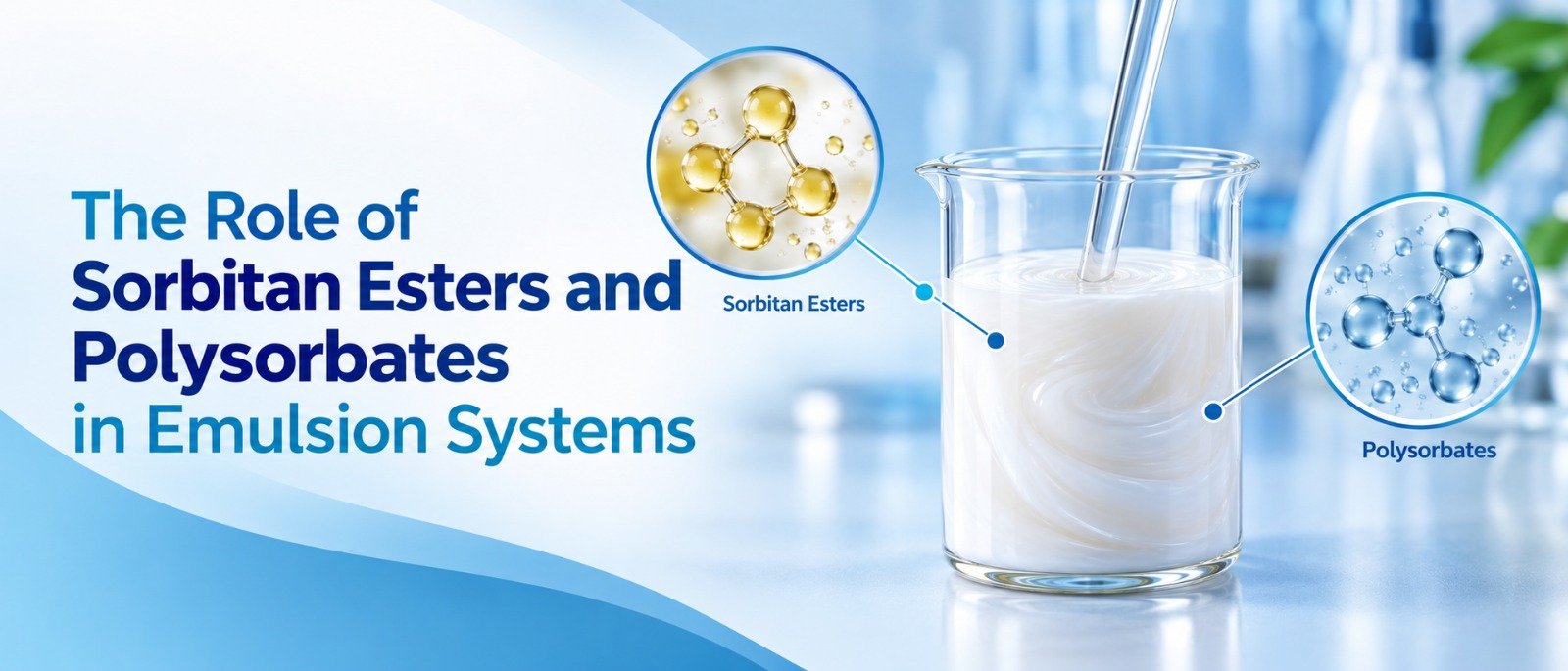

Emulsions are an important part of many industrial formulations where oil and water phases need to be combined and maintained in a relatively stable system. However, because oil and water do not naturally mix, formulators rely on emulsifying agents to improve dispersion and help maintain formulation stability.
Sorbitan esters and polysorbates are two important classes of non-ionic surfactants used in emulsion systems. Their complementary properties make them useful for controlling interfacial behavior, improving dispersion, and supporting the stability of different oil-in-water and water-in-oil formulations.
What Are Sorbitan Esters?
Sorbitan esters are non-ionic surfactants produced by esterifying sorbitan with fatty acids. Different fatty acids can be used to produce grades with different hydrophilic and lipophilic characteristics.
Because of their relatively lipophilic nature, sorbitan esters are commonly considered for water-in-oil (W/O) emulsions, where water droplets are dispersed within an oil phase. Their interfacial activity allows them to position themselves between the oil and water phases and support emulsion formation.
Common sorbitan ester grades include sorbitan monolaurate, sorbitan monopalmitate, sorbitan monostearate, and sorbitan monooleate.
What Are Polysorbates?
Polysorbates are ethoxylated derivatives of sorbitan esters and are also classified as nonionic surfactants. The addition of ethylene oxide groups increases their hydrophilic character compared with their corresponding sorbitan ester counterparts.
Examples include Polysorbate 20, Polysorbate 40, Polysorbate 60, and Polysorbate 80. These grades differ in their fatty acid components and therefore exhibit different formulation characteristics.
Because of their greater affinity for water, polysorbates are commonly considered for oilin-water (O/W) emulsions, as well as for solubilization, wetting, and dispersion applications.
How Do Sorbitan Esters and Polysorbates Work in Emulsions?
An emulsion contains two immiscible phases, generally oil and water. Without stabilization, dispersed droplets tend to collide and merge, eventually resulting in phase separation.
Sorbitan esters and polysorbates can help reduce this tendency by accumulating at the oil-water interface.
Their key functions include:
Reducing Interfacial Tension
Surfactants reduce the interfacial tension between oil and water, making it easier to disperse one phase into the other during mixing or homogenization.
Supporting Droplet Stabilization
Once positioned at the interface, surfactant molecules can form an interfacial layer around dispersed droplets. This can reduce droplet coalescence and contribute to improved physical stability.
Improving Dispersion
Both surfactant classes can help distribute hydrophobic ingredients more uniformly throughout a formulation, depending on the selected grade and concentration.
Sorbitan Esters vs. Polysorbates
One of the most useful ways to understand these materials is to consider their relative hydrophilic and lipophilic characteristics.
| Feature | Sorbitan Esters | Polysorbates |
| Surfactant type | Non-ionic | Non-ionic |
| General character | More lipophilic | More hydrophilic |
| Typical emulsion consideration | W/O systems | O/W systems |
| Water affinity | Lower | Higher |
| Common functions | Emulsification, stabilization | Emulsification, solubilization, dispersion |
| Formulation flexibility | Useful in oil-rich systems | Useful in water-compatible systems |
This comparison is a general formulation guide. Actual performance depends on the specific grade, concentration, oil phase, water phase, temperature, and other ingredients in the formulation.
Why Are Sorbitan Esters and Polysorbates Sometimes Used Together?
In some formulations, combining a more lipophilic surfactant with a more hydrophilic surfactant can provide greater control over the overall emulsification system.
Sorbitan esters and polysorbates can therefore be evaluated as complementary surfactants. By adjusting the ratio of the two, formulators can modify the overall hydrophilic-lipophilic balance (HLB) of the surfactant system.
This approach can be useful when developing emulsions that require specific droplet characteristics, stability, viscosity, or processing behavior.
Industrial Applications
Sorbitan esters and polysorbates can be considered across a broad range of industrial formulation systems, including:
- Personal care and cosmetic formulations
- Industrial emulsions
- Agricultural formulations
- Textile chemicals
- Coatings and specialty chemicals
- Lubricant and process formulations
- Cleaning and detergent systems
- Fragrance and other specialty formulations
The appropriate surfactant or combination should be selected according to the formulation’s specific technical requirements.
How Should Formulators Select the Right Surfactant?
Several factors should be evaluated before selecting sorbitan esters or polysorbates:
Emulsion type: Determine whether the target system is oil-in-water or water-in-oil.
HLB requirement: Identify the approximate HLB required for the oil phase and desired emulsion.
Ingredient compatibility: Evaluate interactions with oils, solvents, polymers, electrolytes, and other surfactants.
Processing conditions: Mixing energy, temperature, homogenization, and order of addition can influence emulsion formation.
Stability: Conduct appropriate stability testing to assess separation, creaming, viscosity changes, and other physical changes.
Frequently Asked Questions
What are sorbitan esters used for?
Sorbitan esters are non-ionic surfactants used primarily for emulsification, stabilization, and dispersion, particularly in systems requiring more lipophilic surfactant characteristics.
What are polysorbates used for?
Polysorbates are non-ionic surfactants used for emulsification, solubilization, wetting, and dispersion in various formulation systems.
Can sorbitan esters and polysorbates be used together?
Yes. They can be evaluated together in some formulations to achieve a desired HLB balance and optimize emulsion stability and performance.
Which is more hydrophilic, sorbitan esters or polysorbates?
Polysorbates are generally more hydrophilic because their structure contains ethylene oxide groups, which increase their affinity for water.
See also: How to Navigate Business Uncertainty
Conclusion
Sorbitan esters and polysorbates provide formulators with complementary tools for developing and stabilizing emulsion systems. Sorbitan esters generally offer more lipophilic characteristics, while polysorbates provide greater hydrophilicity and water compatibility.
Understanding the differences between these surfactants—and how they can work together—allows industrial formulators to design emulsion systems around specific HLB, stability, processing, and performance requirements. Careful grade selection, concentration optimization, compatibility evaluation, and stability testing remain essential for achieving consistent formulation performance.
